
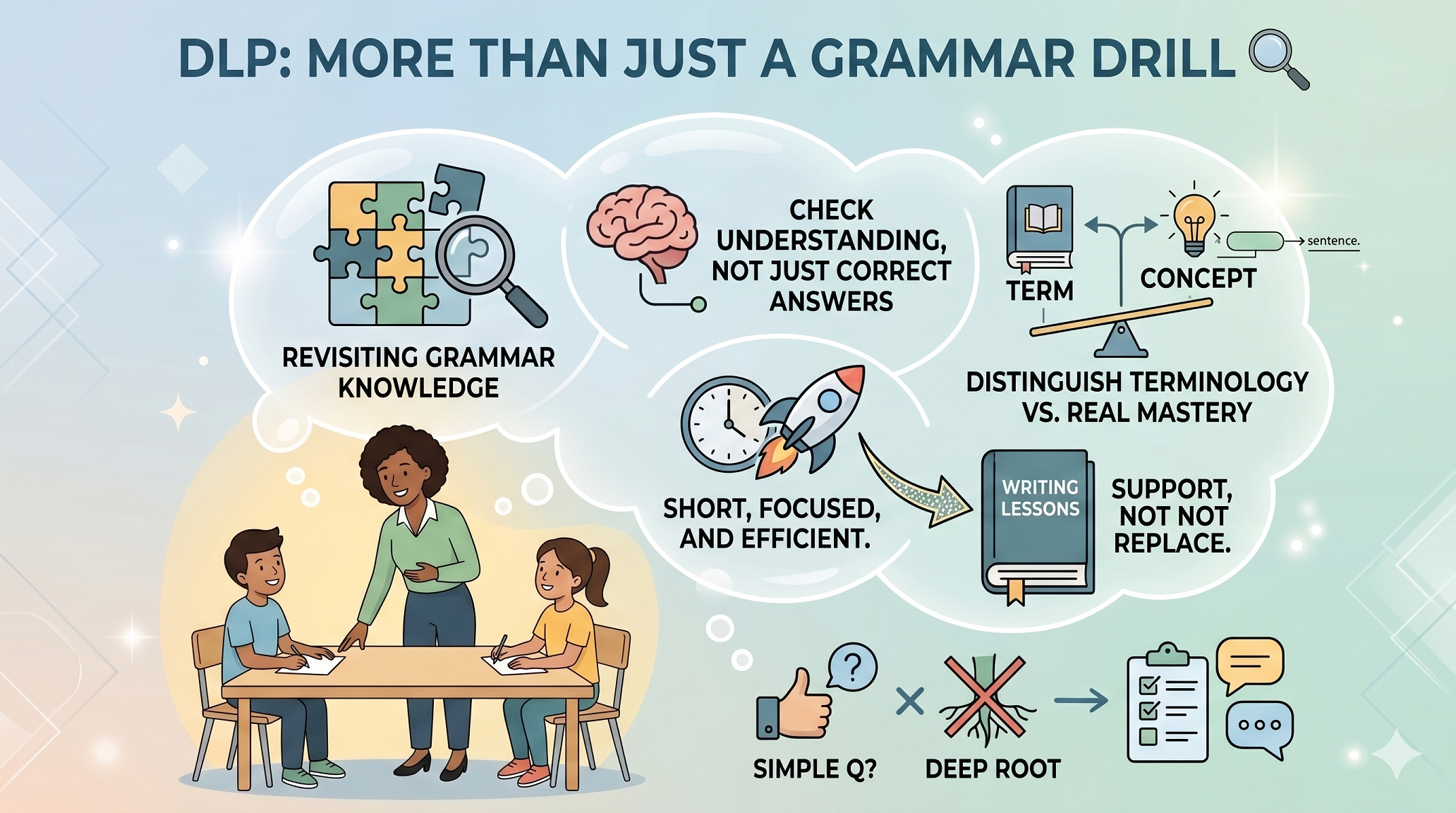
Daily Language Practice is not meant to be a quick question-and-answer exercise. Its real purpose is to help students revisit the grammar knowledge behind each item, and to give teachers a clear window into what students actually understand.
One common pitfall is to stop at the answer. If a student gets it right, we move on; if the answer is wrong, we simply explain the rule and continue. But DLP should go one step further than that: it should help us check whether students truly understand the grammar concept, not just whether they can guess the correct answer.
Another important point is the difference between knowing the concept and knowing the terminology. A student may use subject-verb agreement correctly without being able to explain terms like “subject,” “verb,” or “agreement.” In that case, the issue may be language labels, not actual understanding. Teachers need to tell the difference, so we do not mistake terminology knowledge for real mastery.
That is why DLP should stay short, focused, and efficient. It is there to reinforce a key grammar point in context, not to take over the lesson. When DLP is done well, it supports the main writing lesson instead of replacing it.