
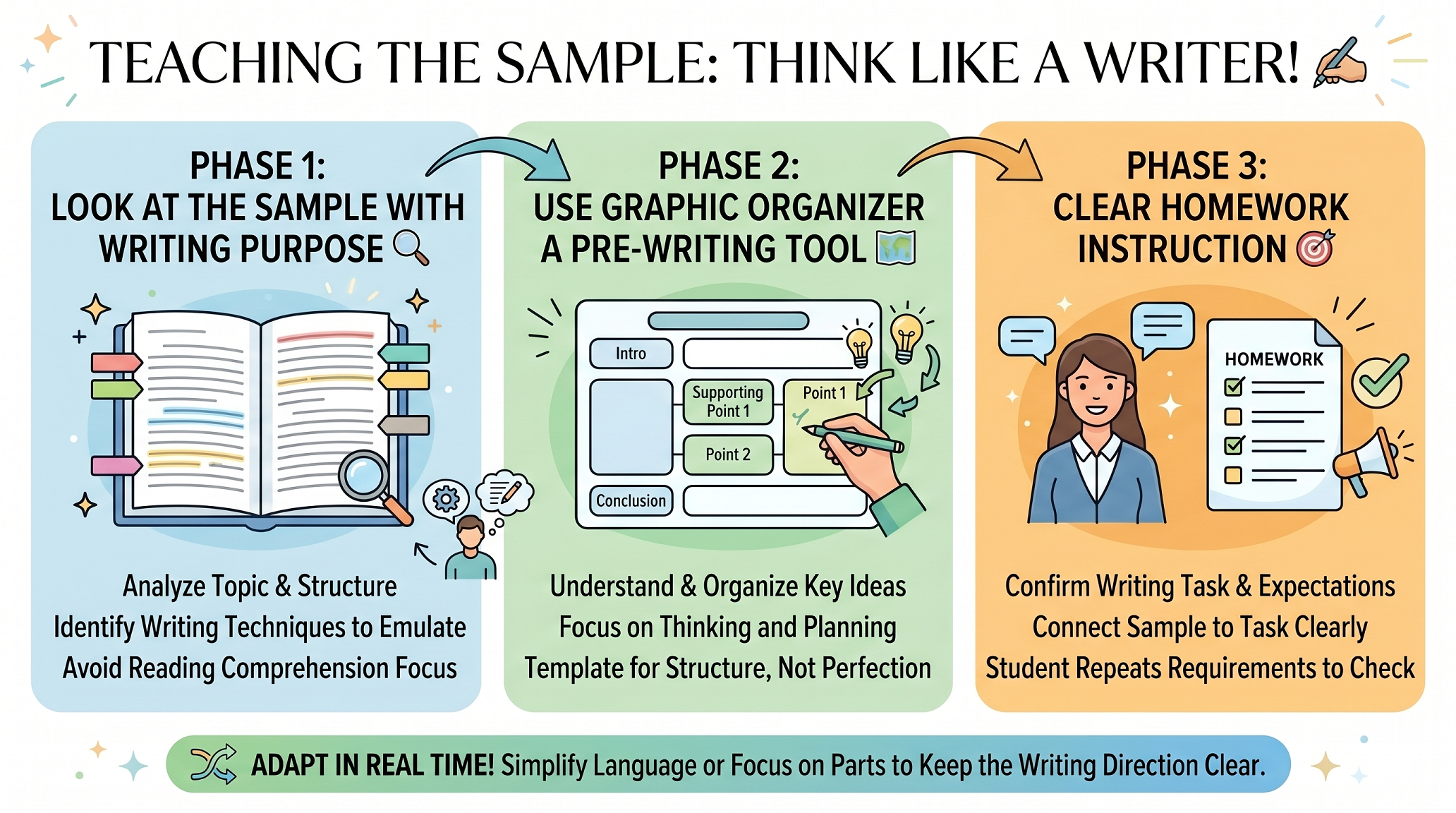
In Lesson 1, the sample should help students think like writers, not just read like readers. The purpose is to show students how a piece of writing is organised, how ideas are developed, and how the sample supports the writing task that follows.
One common mistake is to spend too much time on read-aloud or reading-comprehension style discussion. That shifts the lesson away from writing. Instead, teachers should guide students to look at the sample with a clear writing purpose: What is the topic? How is it structured? What can we learn from it for our own writing?
The graphic organizer should then come in as a pre-writing tool, not the end product. Students should use the sample to understand the structure first, and then move into the organizer to capture key ideas, sequence, and supporting details. It is more important that students learn how to think and plan than to fill in a template perfectly.
Just as importantly, Lesson 1 should end with a very clear homework instruction. Before the class is over, the teacher should make sure students know exactly what the writing task is, what they are expected to do at home, and how the lesson sample connects to that task. A good final check is to have students repeat the writing requirement back in their own words.
If the sample feels too easy, the teacher can push the structural thinking further. If it feels too hard, the teacher can narrow the focus, simplify the language, or work through only part of the sample — but the lesson should still finish with a clear writing direction.