
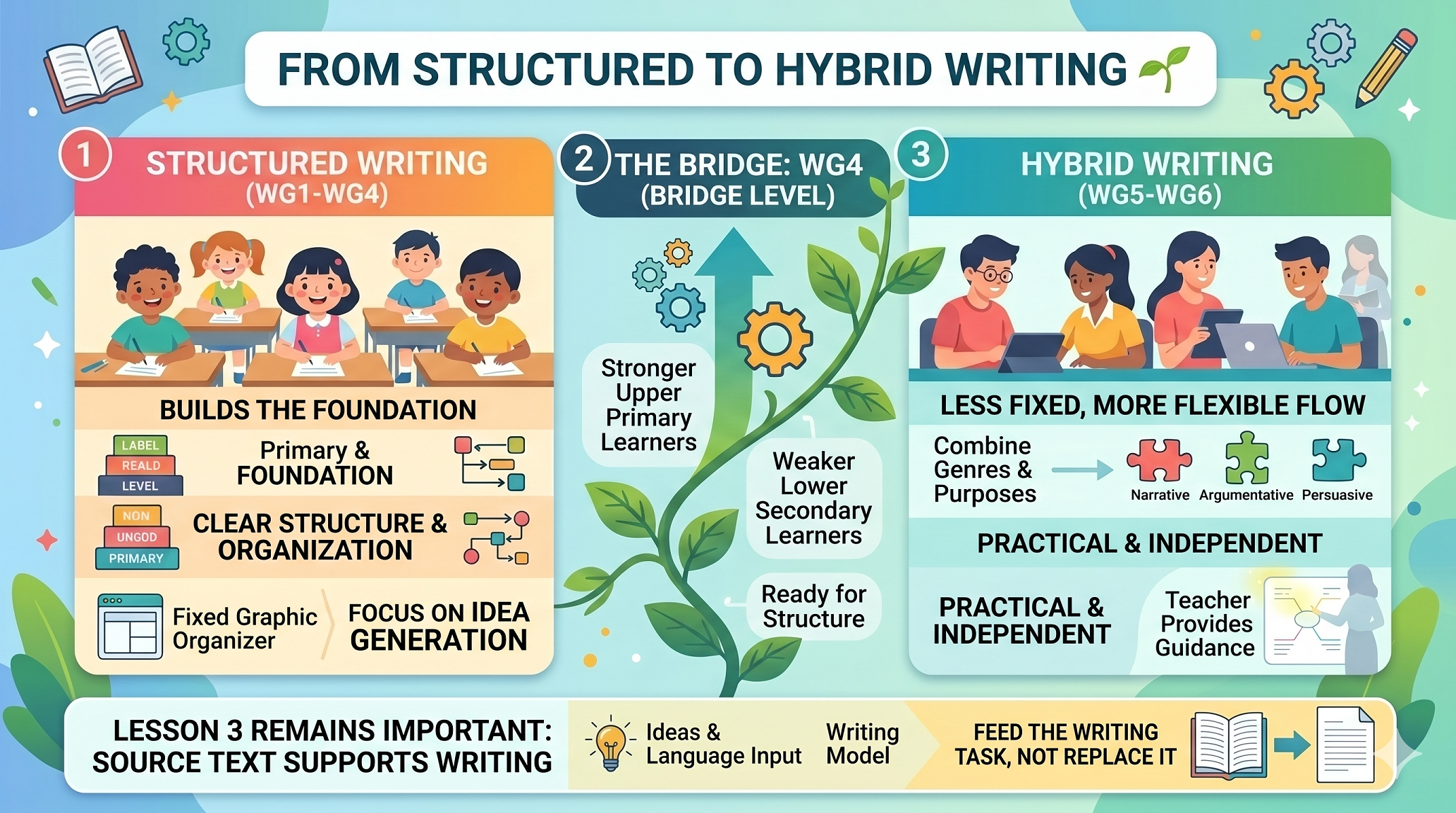
As students move from WG1–WG4 into WG5–WG6, the writing model becomes more flexible. WG1–WG4 belong to our structured writing phase, while WG5–WG6 move into hybrid writing. These levels are designed around students’ writing readiness and programme progression, not around a strict one-to-one match with local school grades.
In practical terms, WG4 is often a bridge level. It can suit stronger upper-primary learners and, in some cases, weaker lower-secondary learners who are ready for more structured writing demands. WG5–WG6, on the other hand, are more suitable for students who are ready to handle more complex, genre-flexible writing tasks.
The key difference is that hybrid writing asks students to combine writing purposes or genres more naturally. The teacher still provides guidance, but the graphic organizer and lesson flow become less fixed, because the task itself is more flexible and practical.
Across all levels, Lesson 3 remains important because the source text supports writing. It gives students ideas, language input, and a model to learn from, but it should not be turned into a reading-comprehension lesson or a long read-aloud exercise. The text should feed the writing task, not replace it.
So the progression is clear: structured writing builds the foundation, and hybrid writing asks students to use that foundation more independently and flexibly. The teaching purpose stays the same — we are still helping students write better, but at a more advanced level of demand.