
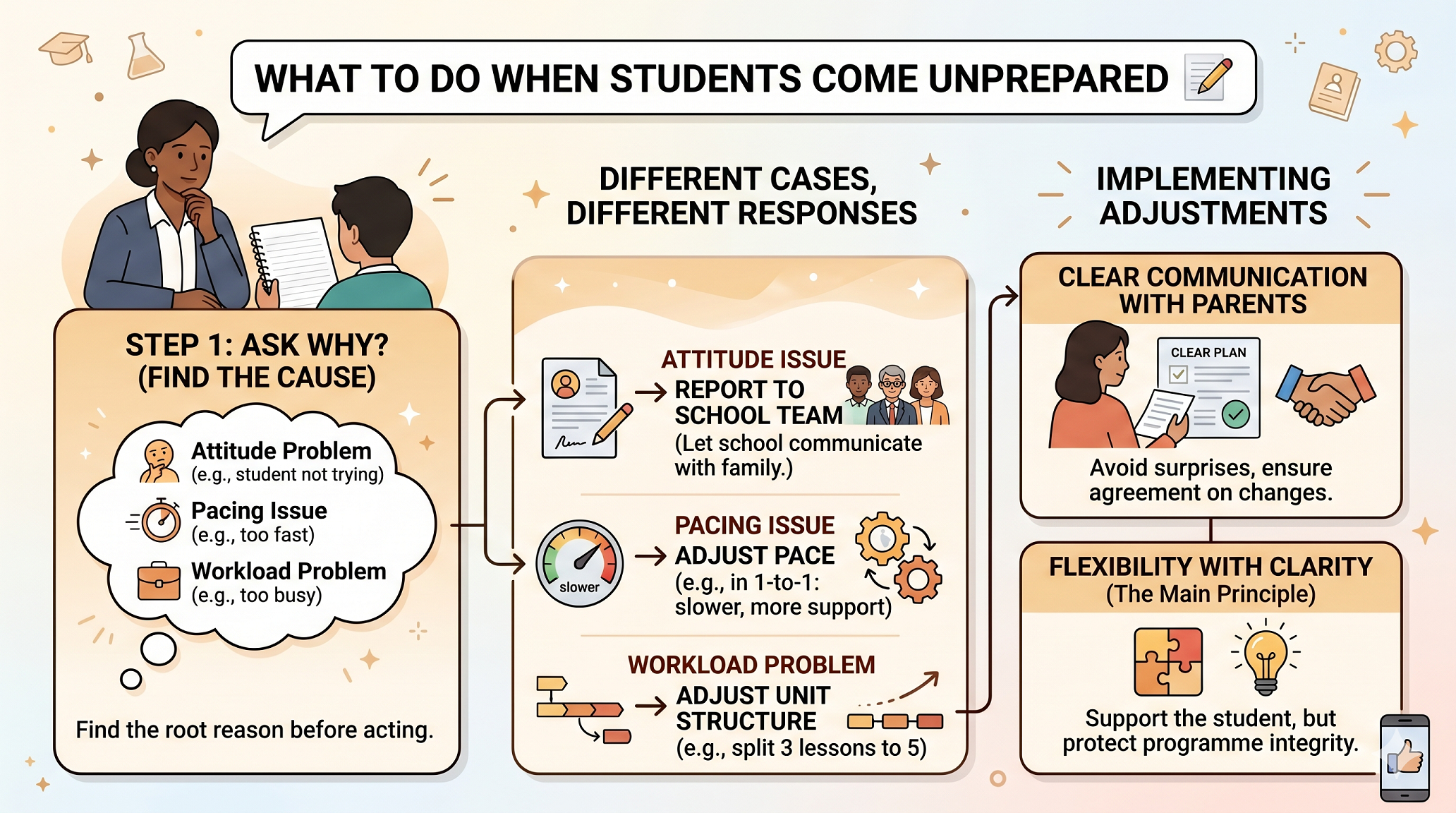
When a student comes to writing class without homework, the first step is not to react immediately — it is to find out why. The missing work may come from an attitude issue, a pacing issue, or simply a workload problem, and each case needs a different response.
If it is mainly an attitude issue, the teacher should report it and let the school or programme team communicate with the family. If it is a pacing issue, then the student may need more in-class support or a slower pace, especially in one-to-one settings.
For some students, especially those who are very busy or who struggle to keep up, it may be more realistic to adjust the lesson structure. In a one-to-one setting, one unit can sometimes be expanded from three lessons to five by splitting the work more gradually, so the student has more time to complete the GO and writing tasks with support.
That said, this kind of adjustment should be handled carefully. It changes the pace and the expectation, so the parent needs to understand it clearly in advance; otherwise, they may feel the lesson is being repackaged. Clear communication matters as much as the lesson adjustment itself.
The main principle is flexibility with clarity. Teachers should support the student where needed, but they also need to protect the integrity of the programme by making expectations transparent and agreed upon.