
Over the past weeks we've shared how our writing programme is structured and how each lesson is meant to run. Along the way, a few of you sent in really good questions — so here are two of the most common ones, answered. As always, this is us sharing what works, not laying down rules. 🙌
Q1. How do we split a lesson into more sessions, when each unit only has three scheduled lessons? Should we notify Protostar? Can we skip a lesson to spend more time on one assignment?
Short answer: we don't skip lessons — we split them, and only after it's been raised and agreed.
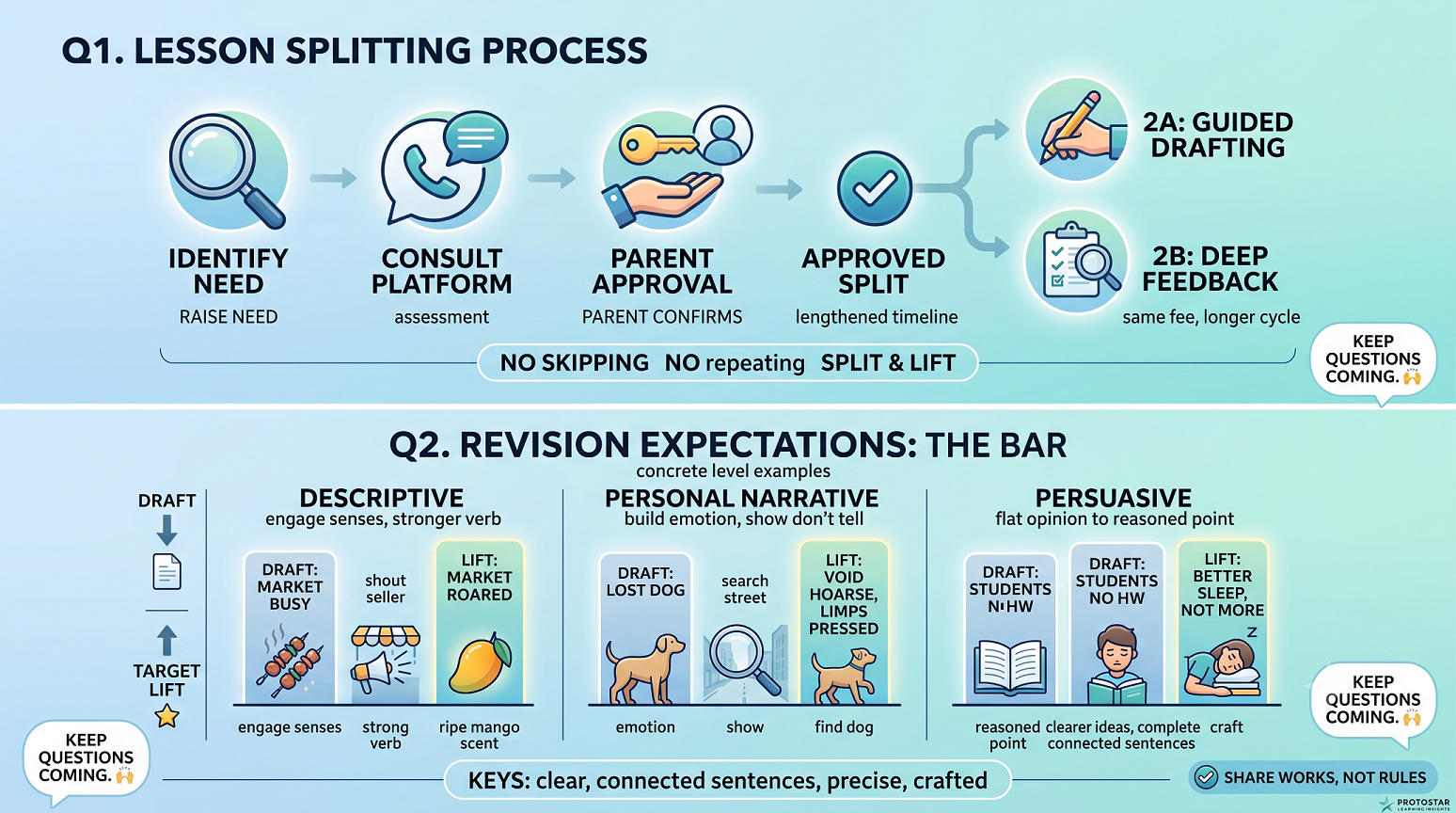
In terms of the model, we can split a writing lesson (Lesson 2 or Lesson 3) into two sessions — let's call them 2A and 2B:
- 2A — The teacher and student work through the task together: shaping the graphic organizer, drafting part of the writing, and sometimes completing a full draft in class.
- 2B — The focus shifts to feedback: marking the GO and draft against the checklist and rubric and the unit's requirements, and lifting the language a level — stronger transitions, better conjunctions, more sophisticated phrasing.
On the process side, this isn't something we change on our own. The teacher should raise the need with their class tutor first (or write to teacherservice). Once we receive it, we assess it and confirm with the parent before making any change — because splitting a unit effectively lengthens the student's learning timeline. The parent is paying the same fee for a longer cycle, and that's the point families care about most. If a parent isn't comfortable with that, we can't push it through; if they agree, we go ahead and implement the change.
🔑 So: don't skip, and don't repeat on your own initiative — flag it, let us align with the parent, then split.
Q2. When we help students improve their essay in Lesson 2 and Lesson 3, how far should we actually take it? What does "good enough" look like?
Earlier posts in this series broke this down part by part — structure, sentences, transitions, word choice, the revision checklist. Here we just want to make the expected level concrete, so we'll let a few examples do the talking.
The goal isn't to rewrite the essay for the student, and it certainly isn't to stop at spelling and grammar. It's to take what the student already wrote and lift it to the kind of sentence a Protostar-trained writer should be producing. A few before-and-after examples of what we mean:
1. Descriptive — engage the senses, use a stronger verb
- Before: The market was busy. There were many people. It was loud. There was lots of food.
- After: The market roared with life — sizzling skewers, shouting sellers, and the sweet sting of ripe mangoes hanging in the air.
2. Personal narrative — build the emotion, show don't tell
- Before: I lost my dog. I looked for him. I found him. I was happy.
- After: I searched every street I knew until my voice went hoarse — and just when I had stopped believing, a small muddy shape limped out from under a parked car and pressed itself into my arms.
3. Persuasive — turn a flat opinion into a reasoned point
- Before: Students should have less homework. Homework is boring. We are tired. So no homework.
- After: Students don't need more homework — they need better sleep. A child who studies until midnight remembers less the next morning than one who closed the books at nine and rested.
Notice none of these are fancy "literary" writing — they're realistic for upper-primary to lower-secondary students. That's the bar: clearer ideas, complete and connected sentences, more precise word choice, and a bit of craft. That is the difference our lessons are meant to make.
Keep the questions coming
These posts are for you, so if anything here raises a new question, leave it in the comments or email us — we'll keep collecting them and sharing answers with the whole community. 💬