
Over the past series, we've walked through the whole writing programme together — from the overall structure, to DLP, to trial classes, to marking the graphic organizer and the essay, all the way to the move from structured to hybrid writing and what to do when students come unprepared. 🙌
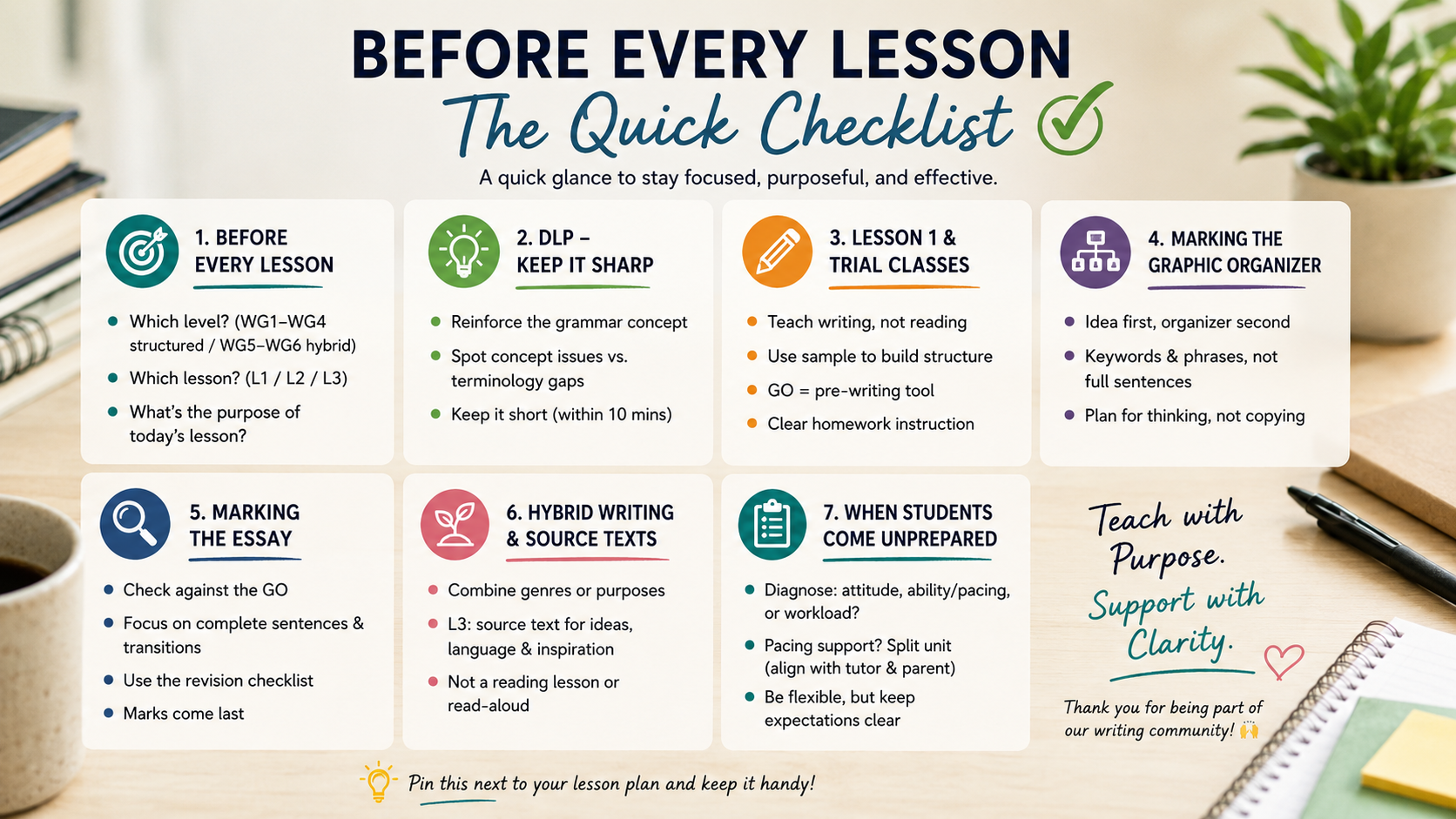
This final post isn't a new topic. It's a takeaway — a single checklist you can glance at before any lesson, at any level. Pin it next to your lesson plan, and use it to remind yourself of the purpose, the priorities, and the pitfalls we've covered.
Before every lesson — the quick check
- Which level am I teaching? WG1–WG4 (structured writing) or WG5–WG6 (hybrid)? Remember: WG levels reflect writing readiness, not local school grades.
- Which lesson in the unit? L1 (sample + structure + set task) / L2 (first writing task, marked against the GO) / L3 (second writing task, supported by a source text).
- What's the one purpose of today's lesson? Say it to yourself in a sentence before class.
DLP — keep it sharp ✅
- Use it to reinforce the grammar concept behind the item, not just to check right or wrong answers.
- Tell apart a student who doesn't understand the concept from one who simply doesn't know the terminology.
- Keep it short — ideally within 10 minutes — so the writing work still has room to breathe.
Lesson 1 & trial classes — teach writing, not reading ✍️
- A trial class is a writing lesson, not a reading class in disguise — assess the student, reassure them, and adapt the difficulty in real time.
- Use the sample to build structural thinking, not for read-aloud or comprehension drilling.
- Treat the graphic organizer as a pre-writing tool — move from ideas to structure, not from text to filling blanks.
- End the lesson with a crystal-clear homework instruction — have the student repeat the writing task back in their own words.
Marking the Graphic Organizer 📌
- Idea first, organizer second — let the student talk, then shape their thinking into structure.
- Keywords and phrases, not full sentences.
- The GO is for thinking, not copying — it's a plan, not a draft essay.
Marking the Essay 🔍
- Always check the essay against the GO — does the structure follow the plan?
- Don't stop at grammar and spelling. Help students build complete sentences and use real transitions and conjunctions.
- Use the revision checklist actively — ideally walk through it with the student.
- Marks come last, after the real teaching has already happened.
Hybrid writing & source texts (WG5–WG6, and L3 everywhere) 🌱
- Hybrid writing asks students to combine genres or purposes — the organizer and lesson flow become more flexible.
- In L3, the source text feeds the writing — it's for ideas, language, and inspiration, not a reading-comprehension lesson or a long read-aloud.
When students come unprepared 📝
- Diagnose first: attitude, ability/pacing, or workload?
- For genuine pacing needs in 1-on-1, a unit can be split (e.g. 3 lessons into 5) — but raise it with your class tutor / teacherservice and let us align with the parent first.
- Flexibility with clarity: support the student, but keep expectations transparent and agreed.
That's a wrap — thank you 🙏
Thank you for following this series and for the questions you've sent along the way. You're experienced, thoughtful professionals, and these posts have only ever been about sharing best practice and the odd reminder. Keep the questions and ideas coming in the comments or by email — this community is at its best when we're learning from each other.
